
24/11/2025
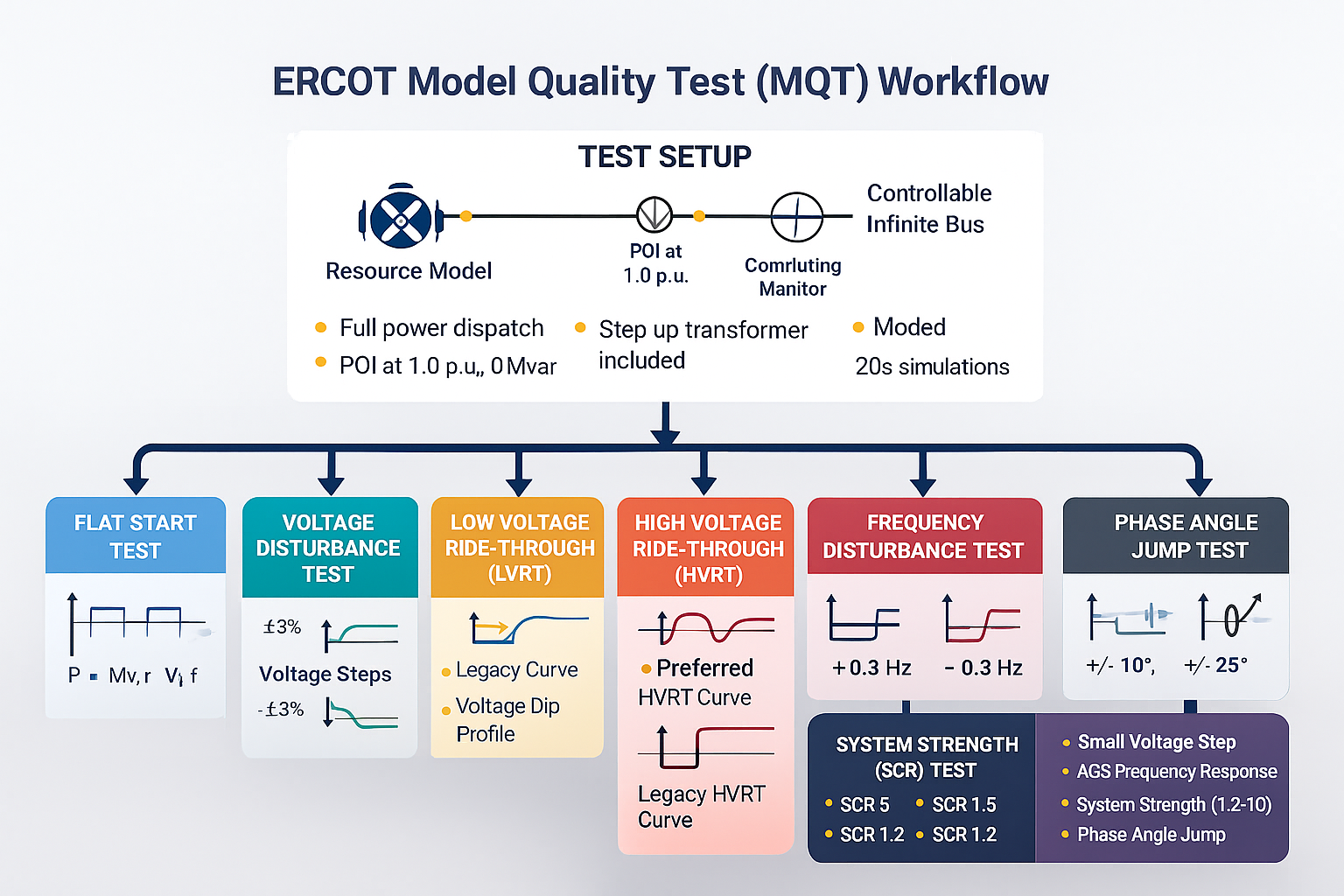
ERCOT Model Quality Tests (MQT): What Engineers Need to Know
Based on ERCOT DWG Procedure Manual, Section 3.1.5
Accurate dynamic models are now a baseline requirement for connecting any inverter-based resource (IBR), wind or solar facility, synchronous generator, STATCOM/SVC, or advanced storage plant in ERCOT. Before a model can be accepted into planning studies, ERCOT requires the full Model Quality Test (MQT) suite.
1. What is the Model Quality Test (MQT)?
ERCOT relies on dynamic simulations to understand how the system behaves during faults, voltage dips, frequency events, and weak‑grid conditions. Those simulations are only as good as the models behind them.
The Model Quality Test (MQT) is a standardized set of simulations that every dynamic model must pass before it’s accepted into ERCOT’s planning and operations studies. Resource owners are required (via ERCOT Planning Guide Section 6.2) to:
The goal is simple: prove that your model behaves like a real, grid‑connected facility over a wide range of credible disturbances.
Below is a technical summary of the exact tests, expectations, and performance criteria defined in Section 3.1.5 of the ERCOT DWG Procedure Manual.
2. Simulation Framework
All MQT tests use a standardized testbench:
This setup ensures the model is evaluated independently of ERCOT system topology.
3. Flat Start Test
Objective: Verify numerical stability and correct initialization.
Criteria:
This test exposes initialization or controller-interaction problems before larger disturbances.
4. Small Voltage Disturbance Test (+3% / –3%)
What ERCOT checks:
Unacceptable: no AVR action, incorrect Q direction, or tripping.
5. LVRT Test (Low Voltage Ride-Through)
Required for IBRs, WGRs, IBTEs, and AGS-ESR.
ERCOT requires testing against two voltage profiles:
1. Legacy LVRT curve
2. Voltage-dip profile (multiple dips, each returning to 1.0 p.u.)
Tests must be run twice:
Performance requirements:
Any model that absorbs reactive power during recovery is considered incorrect.
6. HVRT Test (High Voltage Ride-Through)
Also required for IBRs, WGRs, IBTEs, AGS-ESR.
Profiles:
Performance expectations:
Weak reactive response during the high-voltage period is unacceptable.
7. Small Frequency Disturbance Test (±0.3 Hz)
Required for all technologies.
Setup:
Criteria:
This test ensures the frequency response implementation is realistic.
8. System Strength (SCR) Test
Required for IBRs and IBTEs.
SCR values to be tested:
Method:
Acceptance thresholds:
This test exposes issues in current-limited control, PLL behavior, and voltage-control loops.
9. Phase Angle Jump Test (PSCAD only)
Required only for PSCAD models of inverter-based resources.
Purpose: Evaluate stability when subjected to sudden voltage-angle steps (e.g., ±10°, ±25°).
Criteria:
This verifies PLL/inner-loop performance during severe phase disturbances.
10. AGS-ESR Additional Tests
Advanced Grid Support Energy Storage Resources must also run:
These tests ensure grid-forming or grid-supporting capabilities.

Why This Matters
MQT has evolved into a strict compliance and model-quality requirement in ERCOT. The results directly affect:
A model that fails any of the above tests can be rejected, forcing re-tuning or re-submission. For developers and consultants, understanding these tests is essential to avoid delays and ensure correct dynamic behavior.