18/05/2026
AI data centers are becoming one of the most important new loads on modern power systems. Unlike traditional commercial loads, they are large, concentrated, power-dense, and increasingly dynamic. A single hyperscale data center can demand tens or even hundreds of megawatts, while AI training and inference workloads can create sharp changes in electrical demand.
This is why battery energy storage is becoming more than a backup system. In the new data-center power model, batteries can reduce demand spikes, support reliability, provide fast frequency response, and help the facility interact intelligently with the grid.
Why Data Centers Are a Grid Challenge
Historically, data centers were treated as large but predictable loads. Their main power-system requirement was reliability: dual utility feeds, UPS systems, backup generators, transfer switches, and strong protection schemes.
AI has changed that.
GPU-based workloads increase both total energy consumption and instantaneous power demand. Cooling loads also rise because high-density computing produces intense heat. As a result, the data center becomes not only a consumer of electricity, but a fast-changing electrical system connected to the grid.
The challenge is not only energy in MWh. It is power in MW, ramp rate, location, and timing.
A simplified data-center power balance is:

If battery storage is properly controlled, the grid does not need to see every internal load fluctuation. The battery acts as a buffer between the data center and the utility system.
Role 1: Reducing Demand Spikes
Battery energy storage can reduce peak demand by discharging during high-load periods. This is known as peak shaving.
For example, if a data center normally imports 120 MW but briefly rises to 160 MW during intense AI computation, a 40 MW battery discharge can keep the grid import near 120 MW.
This helps in several ways:
- Reduces stress on transformers and feeders
- Lowers demand charges
- Delays or avoids grid upgrade requirements
- Reduces voltage fluctuation at the point of common coupling
- Makes data-center interconnection more manageable
Battery systems can also provide ramp-rate control. Instead of allowing the grid import to jump suddenly, the battery smooths the transition.
Fast internal load increase -> battery discharges -> grid sees slower ramp
Fast internal load decrease -> battery charges -> grid sees smoother reduction
This is valuable because power systems are often stressed by sudden changes, not only by total load.
Role 2: Backup and Resilience
Data centers already use UPS batteries, but traditional UPS systems are mainly designed for short-duration ride-through. Their job is to keep servers online until backup generators start or another power source takes over.
Modern battery energy storage can expand this role.
A larger BESS can provide:
- Instantaneous backup during grid disturbances
- Seamless transition between grid and islanded operation
- Support for black-start sequences
- Backup for cooling and auxiliary systems
- Reduced dependence on diesel generators for short outages
This does not mean batteries always replace generators. For long-duration outages, generators may still be required. But batteries improve power quality and response speed in ways rotating machines cannot.
With grid-forming inverter controls, a battery system can even help establish voltage and frequency inside a data-center microgrid. This makes the facility more resilient during abnormal grid conditions.
Role 3: Frequency Regulation
Frequency regulation is one of the most technically interesting applications.
In an AC power system, frequency reflects the balance between generation and load. If load is greater than generation, frequency drops. If generation is greater than load, frequency rises.
Battery systems can respond very quickly to frequency deviations.
A simple control relationship is:

If frequency falls below nominal, the battery discharges or reduces charging. If frequency rises above nominal, the battery charges or reduces discharge.
Because batteries respond in milliseconds, they are excellent for fast frequency response. A data-center BESS can therefore support the grid while still protecting the critical IT load.
The key requirement is control priority. Reliability must always come first. The battery management system must reserve enough state of charge for emergency backup before offering grid services.
The New Architecture
A modern grid-supporting data-center architecture may include:
Utility Grid
|
Transmission / Distribution Substation
|
Point of Common Coupling
|
Medium-Voltage Switchgear
|
Transformers and Protection Relays
|
UPS + Power Distribution
|
IT Load and Cooling Load
|
Battery Energy Storage System
|
Power Conversion System + Energy Management System
The energy management system is the brain of this model. It decides when the battery should charge, discharge, hold reserve, support frequency, reduce peak demand, or prepare for an outage.
Different controls operate at different time scales:
Milliseconds: UPS response, inverter control, voltage ride-through
Seconds: frequency response, power smoothing
Minutes: peak shaving, demand response, cooling optimization
Hours: energy arbitrage, renewable firming
Days: outage preparation and maintenance planning
Technical Challenges
This model is powerful, but it is not simple.
Battery degradation must be considered. Frequent cycling for grid services can reduce battery life if not managed correctly.
Protection coordination also becomes more complex. Inverter-based resources do not produce fault current like synchronous machines, so relay settings and fault-detection methods may need to be updated.
Power quality is another concern. UPS systems, rectifiers, inverters, and fast-changing server loads can introduce harmonics, voltage flicker, and reactive power issues.
Cybersecurity is also critical. A grid-interactive data center communicates with control systems, market platforms, or utilities. That communication must be secure because the facility is both a critical load and a potential grid resource.
Why This Matters
Battery storage does not make data centers consume less energy by itself. But it changes how they consume power.
That difference is important.
A passive data center simply takes power from the grid whenever it needs it. A grid-interactive data center can shape its demand, reduce peaks, support frequency, improve resilience, and help integrate renewable energy.
In the future, the best data centers may not only be judged by uptime and computing performance. They may also be judged by how intelligently they interact with the power system.
The next generation of data centers will not just be digital infrastructure. They will be active electrical infrastructure.
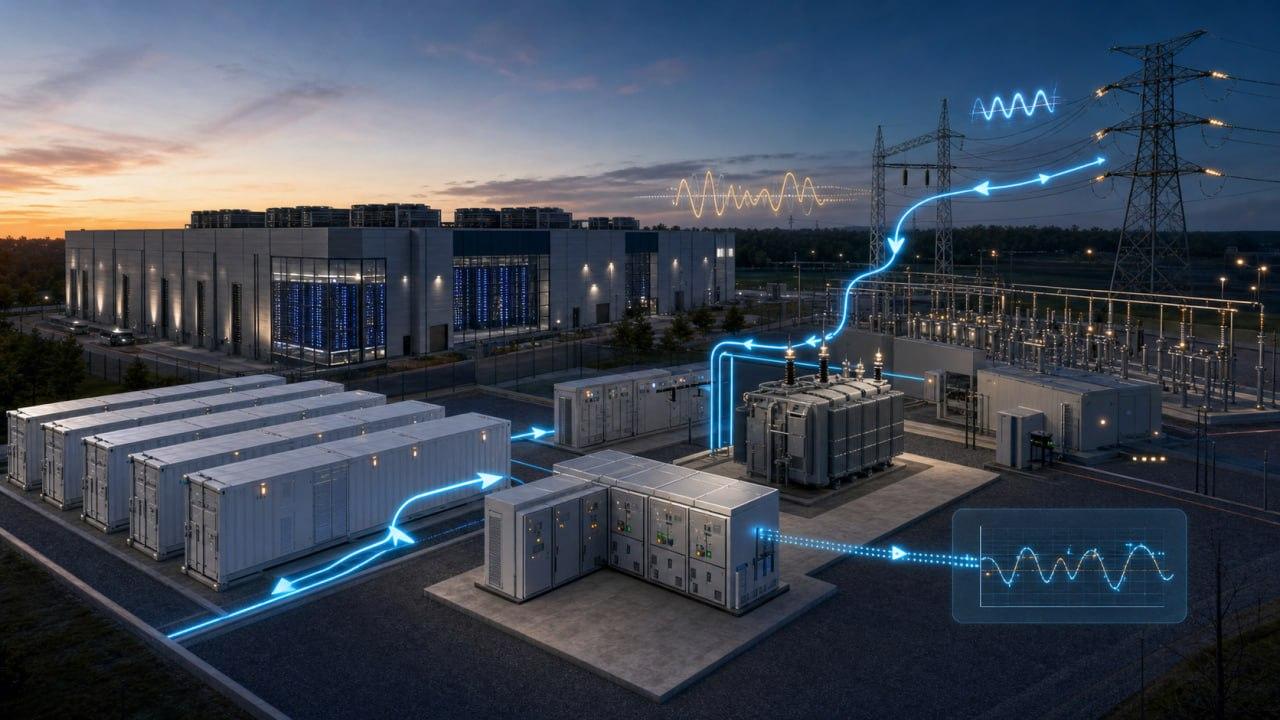
Technical illustration of an AI data center connected to battery energy storage, a substation, and the electric grid with bidirectional power flow.
**References:**
[IEA Energy and AI](https://www.iea.org/reports/energy-and-ai/energy-demand-from-ai)
[IEA Electricity 2026](https://www.iea.org/reports/electricity-2026)
[U.S. EIA battery storage grid services](https://www.eia.gov/todayinenergy/detail.php?id=50176)